


Latifa Echakhch - Frames
What it means to belong somewhere
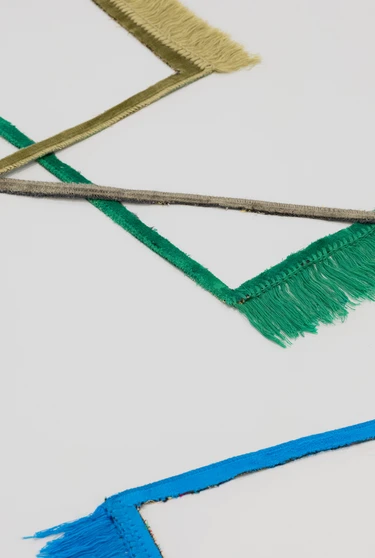
In her work Frames, Latifa Echakhch uses prayer mats with the centres cut out. What remains is a frame. The absence leaves room for imagination. When someone migrates, they carry their own frames of reference to a new place. Upon arrival, those frames are filled again ‒by themselves and by others. In this process, we become aware of our own assumptions and expectations.
“I am Moroccan, but I do not speak Arabic at all. I was not raised in Arabic culture; I feel more French than Moroccan. It’s like I am nowhere in the right position.”
Latifa Echakhch’s work often reflects that feeling of existing in-between. In her art, she explores what it means to belong somewhere – and what it’s like when belonging isn’t a given. Fenix curator Yev Kravt interviewed Latifa Echakhch about belonging, absence, and memories.
Yev Kravt: In Frames, you remove the ornamental and symbolic centre of the carpets. What new paths of thinking does this gesture open?
Latifa Echakhch: Removing the centre of the carpet is a way of destabilising an object that carries strong symbolic and cultural authority. By subtracting what is usually ornamental and meaningful, the carpet shifts from a functional or ritual object to a trace or structure.
Meaning is no longer fixed or embedded in a central motif; instead, it becomes something projected by the viewer. What remains, the frame, the outline, the residue, becomes more important than what has been removed.
The carpet is often associated with comfort, prayer, and home. Does this work reshape the idea of “home” for you?
By removing their function and centre, I create a sense of estrangement rather than familiarity. For me, home is not a stable or nostalgic concept but something fragmented and constantly renegotiated. The work reflects an experience of displacement, where home exists more as memory and projection than as a fixed place.
You once said that memories are never purely personal. In your work, private histories seem to connect to collective ones. How do you navigate this space between what is yours and what belongs to many?
I use personal elements, not to illustrate my own story, but as a starting point that everyone can recognise. I choose basic, ordinary objects, a shirt, a glass of wine, because they are banal and shared. Their simplicity allows audiences to project their own memories onto them.
The work transforms personal fragments into something that belongs to collective experience, acting as a facilitator for shared memory. It is not about preserving my own history, but about activating the viewer’s associations with familiar forms and bridging private and collective realms.
Your work often speaks through what is missing rather than what is present. What does absence mean to you?
Absence is not emptiness but potentiality, a space where meaning can emerge through perception and projection. By presenting things that are not fully there, removed centres, suspended strands, ghostly silhouettes, the work creates tension between opposing states.
Absence allows time to be suspended: what is missing makes visible the after, the before, and the in-between. It reveals how perception, memory, and imagination fill the gaps, inviting viewers to complete what is not materially present.
Finally, do you believe there is something like a specifically female perspective on migration?
I do not think the experience of migration is confined to gender. However, being both a woman and an immigrant shapes how I experience legitimacy, belonging, and visibility in the world. The feeling of being neither entirely here nor there, existing in an out-of-place position, may resonate differently with women because social expectations around belonging, work, and identity intersect with gender.
At the same time, migration is complex and not singular. It overlaps with cultural stereotypes, gendered expectations, and personal histories in ways that cannot be reduced to one fixed perspective. My work seeks to open space for multiple narratives and collective histories without claiming a singular gendered truth.

In-between route
We’ve selected ten women artists from the Fenix collection ‒ hailing from different countries, generations, and walks of life ‒ each finds themselves, in their own way, in an in-between space. The ten artworks are compiled into a route through the exhibition All Directions.

photography on this page: Titia Hahne


